<img height="1" width="1" style="display:none;" alt="" src="https://px.ads.linkedin.com/collect/?pid=3436946&amp;fmt=gif">
Coaching.com logo

The companies Lisa has worked with:

g4 (2) HUFFPOST Business Insider logo Vector-3 Group 4863

 The Problem Starts Before Your Clients Walk In

Before we talk about helping your clients overcome Imposter Syndrome, let's talk about you. As coaches, we're no more immune to it than the clients we serve. High achievers with high standards are often the ones least likely to notice it underpinning their own behavior. It usually shows up disguised as professionalism, perfectionism, or simply "having high standards."

You over-prepare. Spending hours preparing for a session you were already more than qualified to deliver. 


You perfect endlessly. Re-writing the website for the fifth time until it’s ‘just right’ or editing the book yet again before you send it to the publisher.

You wait to be ready. Telling yourself you'll put yourself out there once you're ready. Readiness never arrives on its own.

From the outside, these behaviors could look responsible. No one realizes it's covering a quieter question: "Am I really good enough?" As a result, brilliant coaches undercharge, overwork, stay invisible, and hesitate at exactly the moments that could transform their business. They confuse caution with competence and preparation with progress.

Most coaches are familiar with Imposter Syndrome. Familiarity isn't the same as mastery. The more you understand how it disguises itself and shapes behavior, the better equipped you'll be to address it in yourself and with your clients. 

What Imposter Syndrome Actually Is

Most people think Imposter Syndrome is a lack of confidence. It isn't.
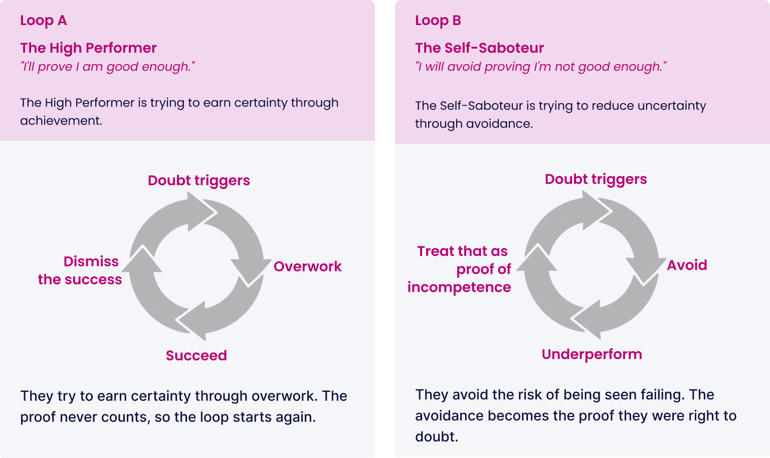
Although Imposter Syndrome can show up in many different ways, most people fall into one of two predictable patterns, both driven by how people respond to doubt.

image

Why Most Coaching Makes It Worse

As coaches, we naturally help clients build confidence, challenge limiting beliefs, and recognize their strengths. These are exceptional coaching tools, but they're designed to address a different problem. When someone is caught in an Imposter Syndrome loop, confidence alone won't break it. Building confidence in someone caught in the loop often just hands them more evidence they'll reinterpret or dismiss. The loop stays intact. 

This masterclass will help you recognize the loop, understand the mechanism driving it, and learn the interventions that create lasting change.

 What This Masterclass Covers

You’re Solving the Wrong Problem

Why confidence isn't the intervention. Confidence Coaching and Imposter Syndrome Coaching are not the same thing. When you build confidence in someone caught in an Imposter Syndrome loop, you're often giving them more evidence they'll simply reinterpret or dismiss. The loop stays intact. Learn to correctly identify the distinct Imposter Syndrome Patterns emerging with your clients. 


You're Creating Relief, Not Change

Why clients leave inspired, then come back with the same problem. We've all had those sessions. The client leaves feeling lighter, more confident, convinced they've had a breakthrough. Then two weeks later, they're back. Different story. Same loop. The problem isn't your coaching. It's that insight doesn't automatically change interpretation. Explore different approaches to overcome the self-reinforcing nature of Imposter Syndrome.


You're Treating the Symptoms, Not the System

Why perfectionism, procrastination, and people-pleasing all have the same root cause. Perfectionism. Overpreparing. Procrastination. Staying invisible. People-pleasing. They may look like different challenges, but they're often different expressions of the same underlying Imposter Syndrome loop. Discover a practical, research-backed framework for identifying the pattern beneath the behavior, interrupting the loop, and creating sustainable change.

 This Is for You If:

You've coached it before, and watched it come back. You default to encouragement and reframing, but you know something deeper is driving the behavior.


You want a framework, not another mindset trend. You're looking for a defined specialization grounded in research and clinical practice,  not another generic mindset framework.


You know it's affecting you, too. You're charging less than you're worth, hesitating before bigger opportunities, or playing smaller than you're capable of, and you suspect the biggest barrier isn't the market. Coaching with integrity requires you to address this loop in yourself first.

What Coaches Are Saying

Shana Shallenberg

Imposter Syndrome Coach

Vicki Staebler Tardino, PhD

Organizational Consultant & Executive Coach

Basil Denno

Executive Leadership Coach

Photo of Sarifa Moola-Nernæs
Sarifa Moola-Nernæs
Coach
“I had a client that was struggling to find employment in her field. After working through some of the tools, she was able to identify the triggers. She now got a job in her profession in local government after 2 Masters, a few courses and many years of trying.”
Photo of Dr. Phyllis Clark
Dr. Phyllis Clark
CEO, Clark Training & Consulting
“One client recently shared that they had been feeling stuck in their work due to impostor syndrome, but after just a single 30-minute session with me, they felt an immediate shift. They left the session with practical strategies to implement right away, and they’ve already begun seeing positive results.”
Photo of Frankie B.
Frankie B.
ADHD Coach for Professionals in Tech
"Three thought leaders who have shaped my life and deserve wider recognition: Dr. Lisa Orbé-Austin, an expert on the imposter phenomenon (also known as imposter syndrome) and an extraordinary executive coach. I would not be where I am today without her expertise, resources, and unwavering support."
Photo of Rachel K.
Rachel K.
Leadership Coach
"Dr. Lisa’s deep understanding of Imposter Syndrome has shown me how this framework can unlock powerful changes in my clients’ self-perception. I’m looking forward to using her tools to guide clients through their most persistent struggles with confidence and authenticity. I can already see the impact this will have on their personal and professional lives."
Photo of Jane T.
Jane T.
Career Coach
"Dr. Lisa’s approach has made a significant impact on my coaching practice. Her methodology provides a fresh perspective on supporting clients as they navigate feelings of inadequacy. I now feel better equipped to help them reframe their beliefs and move forward with renewed confidence"
Photo of Carlos O., PhD
Carlos O., PhD
Executive Coach and Learning & Development Specialist
"Dr. Lisa’s insights into Imposter Syndrome are invaluable. I feel prepared to help clients challenge the limiting beliefs that keep them stuck. Her practical tools promise to be game-changers, especially for high-achievers who often feel like 'frauds.' I’m excited to bring this structured approach into my sessions."
Photo of Michael D.
Michael D.
Business Coach
"Understanding Imposter Syndrome through Dr. Lisa’s lens has been a revelation. I’m ready to apply these insights to help clients internalize their achievements rather than downplay them. The potential impact of these tools on my clients’ self-esteem and overall success is undeniable."
Photo of Emily R.
Emily R.
Wellness Coach
"Even before working directly with Dr. Lisa, I can recognize the value of her insights into Imposter Syndrome. Her framework will help me address the deep-seated self-doubt my clients often face, enabling me to support them in acknowledging their accomplishments and embracing new opportunities."
Photo of David S.
David S.
Executive Coach
"Lisa’s framework for addressing Imposter Syndrome is the breakthrough I’ve been looking for. With her guidance, I’m excited to help clients let go of their fears of inadequacy and build a positive, empowering self-image that will drive them toward their goals."
Photo of Angela P.
Angela P.
Leadership Development Coach
"The way Dr. Lisa breaks down Imposter Syndrome is practical and actionable. I’m ready to incorporate her techniques into my coaching practice, helping clients shift from downplaying their achievements to truly owning them. This course is going to elevate my ability to support their growth."
Photo of Kevin L.
Kevin L.
Personal Development Coach
"Dr. Lisa’s approach has opened my eyes to the ways Imposter Syndrome holds my clients back. I’m excited to use her tools to help them see their self-worth and confidently step into their potential. Her expertise feels like the foundation my clients need for lasting change."
Register today to unlock a practical coaching tool you can apply in your very next session.
IS 2026 - Web Asset - Thumbnail - Tool 1

Quiz: Are You Accidentally Reinforcing Imposter Syndrome in Your Clients?

This 7-minute quiz helps coaches identify the coaching “lens” shaping how they work with clients’ imposter syndrome, including where their natural style may unintentionally create a ceiling on client growth. You’ll receive a personalized result outlining your core strength, a structural blind spot, and one concrete action to expand your impact—plus two follow-up resources over the next week.

About Dr. Lisa Orbé-Austin

Group 6356771 (2)

Dr. Lisa Orbé-Austin is a licensed psychologist and executive coach with around 20 years in practice, specializing in Imposter Syndrome, career advancement, and DEI. She holds a doctorate in Counseling Psychology from Columbia University, Teachers College, and co-founded Dynamic Transitions Psychological Consulting with her husband, Dr. Richard Orbé-Austin.

She is a co-author of three books on Imposter Syndrome and career development: Own Your Greatness (2020), Your Unstoppable Greatness (2022), and Your Child's Greatness (2025). 

Own Your Greatness was a finalist, while Your Child's Greatness won the Indies Forward Book Award. She delivered the famous TEDxDeerPark talk The Imposter Syndrome Paradox, which has reached over 1.5 million views across platforms.She contributed the chapter to the American Psychological Association (APA) volume edited by Kevin Cokley, The Impostor Phenomenon: Psychological Research, Theory, and Interventions. 

She is a 2X LinkedIn Top Voice and was named to the inaugural Thinkers50 Coaches50 list. 

Register Today
for the Masterclass