Register Now

You've coached it before, and watched it come back.
You default to encouragement and reframing, but you know something deeper is driving the behavior.

Free 75-Minute Live Masterclass
.png?width=1378&height=1048&name=Image%20with%20dates@2x%20(4).png)
.png?width=65&height=64&name=g4%20(2).png "g4 (2)")




Before we talk about helping your clients overcome Imposter Syndrome, let's talk about you. As coaches, we're no more immune to it than the clients we serve. High achievers with high standards are often the ones least likely to notice it underpinning their own behavior. It usually shows up disguised as professionalism, perfectionism, or simply "having high standards."
Spending hours preparing for a session you were already more than qualified to deliver.
Re-writing the website for the fifth time until it’s ‘just right’ or editing the book yet again before you send it to the publisher.
Telling yourself you'll put yourself out there once you're ready. Readiness never arrives on its own.
From the outside, these behaviors could look responsible. No one realizes it's covering a quieter question: "Am I really good enough?" As a result, brilliant coaches undercharge, overwork, stay invisible, and hesitate at exactly the moments that could transform their business. They confuse caution with competence and preparation with progress.
Most coaches are familiar with Imposter Syndrome. Familiarity isn't the same as mastery. The more you understand how it disguises itself and shapes behavior, the better equipped you'll be to address it in yourself and with your clients.

Most people think Imposter Syndrome is a lack of confidence. It isn't.
Although Imposter Syndrome can show up in many different ways, most people fall into one of two predictable patterns, both driven by how people respond to doubt.
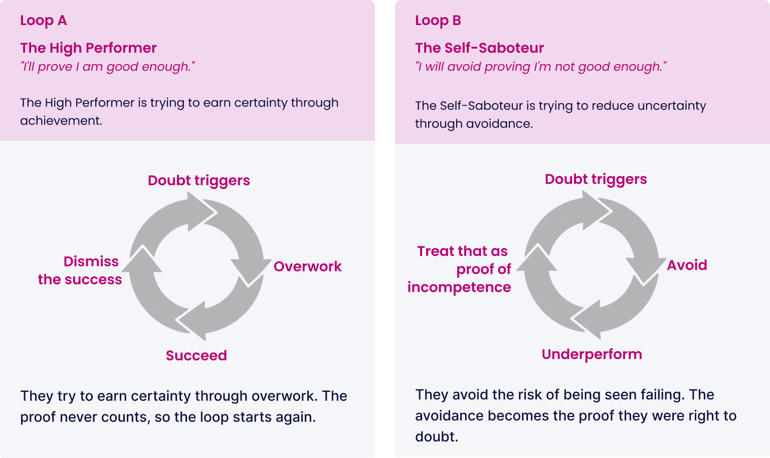
Neither loop breaks with confidence-building. The evidence is already there. The client is rejecting it. That is a cognition problem, not a confidence problem.
Free 75-Minute Live Masterclass
.png?width=500&height=380&name=Image%20with%20dates@2x%20(4).png)
You've coached it before, and watched it come back.
You default to encouragement and reframing, but you know something deeper is driving the behavior.

You want a framework, not another mindset trend.
You're looking for a defined specialization grounded in research and clinical practice, not another generic mindset framework.

You know it's affecting you, too.
You're charging less than you're worth, hesitating before bigger opportunities, or playing smaller than you're capable of, and you suspect the biggest barrier isn't the market. Coaching with integrity requires you to address this loop in yourself first.

Coach

CEO, Clark Training & Consulting

ADHD Coach for Professionals in Tech

Leadership Coach

Career Coach

Executive Coach and Learning & Development Specialist

Business Coach

Wellness Coach

Executive Coach

Leadership Development Coach

Personal Development Coach

This 7-minute quiz helps coaches identify the coaching “lens” shaping how they work with clients’ imposter syndrome, including where their natural style may unintentionally create a ceiling on client growth. You’ll receive a personalized result outlining your core strength, a structural blind spot, and one concrete action to expand your impact—plus two follow-up resources over the next week.