<img height="1" width="1" style="display:none;" alt="" src="https://px.ads.linkedin.com/collect/?pid=3436946&amp;fmt=gif">
Coaching.com logo

Imposter Syndrome Coaching Certification

A research-informed methodology for coaches working with high-achieving clients who secretly feel like fraud.

Next cohort begins September 29, 2026. Seats are limited by cohort format.

25 Weeks Live Learning 55 CCEUs

check15-day money-back guarantee

Image with dates@2x-1
Dr. Lisa Orbé-Austin has worked with::
Financial Times
Google-Images-logo-vector-01 1
Vector (7)
Harvard Graduate School
Yale
starbucks
  THE COACHING THAT STALLS 
Insight is the Easy Part.

The Change is Where It Breaks.


You can already recognize Imposter Syndrome in a client. The high achiever who calls every win luck. The executive who over-prepares for a meeting they could lead cold. The one who hears praise and quietly sets it aside. You name the pattern. You ask the question that makes them pause. They have a real moment of clarity, and they leave the session lighter.

Two weeks later, the same client walks back in, running the same loop. It happens because awareness was never the missing piece. Your client could describe their Imposter Syndrome before they booked the call. They have read the articles. They can name the fear. And they still cannot stop the behavior, because understanding a pattern and interrupting one are different kinds of work.

Where coaching on this tends to stall:
Sessions that produce realization without follow-through
Confidence work that fades before the next call
Clients who revert the moment the stakes rise
Reassurance that quietly deepens the dependency
No reliable way to tell Imposter Syndrome from burnout
A toolkit that ends exactly where the hard work starts

Coaching this well takes more than instinct and encouragement. It takes a method built for the actual shape of the pattern.

82%
of people experience Imposter Syndrome at some point. It is one of the most common reasons high achievers seek coaching, and one of the most consistently mishandled.
Bravata et al., 2020, a meta-analysis of 62 studies, published in the Journal of General Internal Medicine. 
Are you equipped to meet that demand with a method, rather than instinct?
  INTRODUCING  

The Imposter Syndrome Coaching Certification


A 25-week certification that gives coaches a structured, research-informed way to move clients past recognition and into measurable, lasting change. Built and delivered by Dr. Lisa Orbé-Austin, licensed psychologist and a leading authority on Imposter Syndrome, it is organized around one repeatable framework you can apply across very different clients: the 3C's Methodology.

check15-day money-back guarantee

  WHY MOST Approaches FALL SHORT  

A Four-layer Pattern Resists a One-layer Fix


Imposter Syndrome is widely treated as a confidence shortage. That framing is why so much coaching on it underperforms. The construct carries more than four decades of peer-reviewed research, and the research describes something deeper: an identity-level pattern that runs across cognition, behavior, narrative, and relationships at the same time. Coach one layer, and the others pull the client back. Adjust the thinking, and the old behavior reasserts. Change the behavior, and the self-story drags it home. A confidence reframe touches a single layer of a four-layer system, which is why the gains keep dissolving between sessions.

It also explains why the instinctive moves underdeliver. Reassurance feels supportive in the room. For a client whose worth has always run on outside approval, a coach's steady reassurance becomes one more supply of it. Over-validating and over-directing share the same flaw. They soothe the surface and leave the structure untouched. Durable work needs a method that identifies the pattern precisely, intervenes at the behavioral and identity level, and builds conditions that hold the change after the engagement ends.

check15-day money-back guarantee

  The solution  

The 3C’s Methodology


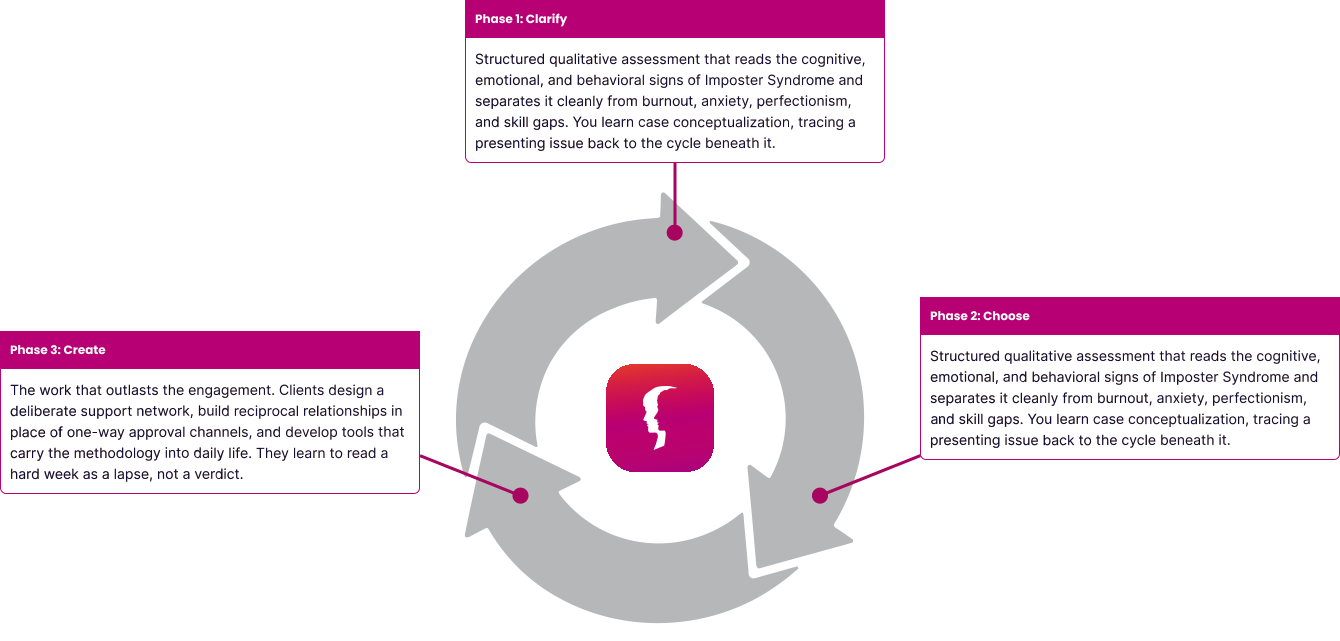
A repeatable, research-informed framework. Three phases run in sequence because the order carries the work. You cannot coach better behavior before the pattern is clear, and change does not last until the client has built an environment that sustains it.


3cs


The 3C's process produced a 30% reduction in Imposter Phenomenon scores, and the reduction held at a six-month retest.
*Measured with the Clance Imposter Phenomenon Scale across two cohorts. A documented program outcome, not a guaranteed result for any individual client.

check15-day money-back guarantee

  The certification pays its way in the work  

The Certification Pays its Way in the Work

This is a specialization decision, and the return shows up in concrete places. Coaches in the predecessor program reported the same shifts after applying the methodology.

20-40%

Higher Rates

Coaches reported raising their rates after the methodology, pricing for a specialization rather than a general practice.

2x

Longer Engagements

Engagements extended from roughly three months to six or eight, because the work keeps producing change instead of plateauing at insight.

55

CCE units

Continuing Coach Education units toward ICF renewal, plus a recognized designation that signals your specialization.

Many coaches who learn to work this pattern in clients resolve it more directly in themselves. That is not the aim of the program. It is a consistent effect, and it makes the work easier to do with conviction.

check15-day money-back guarantee

  THE MYTHS WORKING AGAINST YOU  
Your Client Walks in Already

Believing the Wrong Things


By the time a client reaches you, the internet has handed them a story about Imposter Syndrome. Usually one of three. Each one quietly works against the coaching, because each one tells the client the pattern cannot, or should not, change. Knowing how to answer them is part of the work.

"It is just my type."


The client has taken a quiz and been sorted into a fixed Imposter type. It feels like insight and lands as a verdict. If this is simply who they are, there is nothing to coach. The 3C's replaces the label with something workable: one pattern, expressed through roles, and roles can change.


"It is my superpower."


The client has decided that self-doubt is what drives them, so letting it go feels like losing their edge. They resist the work to protect the engine. The evidence ties Imposter Syndrome to anxiety, burnout, and fear-based effort, not healthy drive. Naming that frees the client to change without feeling they are giving something up.

"It is all in my head."


The client believes the fix is a mindset adjustment, so they wait for the right reframe and stay frustrated when it does not hold. Affirmations alone do not move an identity-level pattern. The 3C's shows the client why and gives them the behavioral and relational work the belief change actually needs.

Every one of these is resistance you are already coaching against, whether or not it gets named in the room. The certification gives you a clear, research-grounded answer to each, so the myth stops setting the ceiling on what your client believes is possible.

check15-day money-back guarantee

  THE CURRICULUM  
What You'll Learn 

Inside the Certification


12 modules in 2 arcs, moving you from recognition to intervention, to mastery.

Modules 1 to 7 — Foundations and core methodology

  • Identify Imposter Syndrome and differentiate it from burnout, anxiety, or skill gaps
  • Conduct structured Imposter Syndrome assessments
  • Understand the Imposter Cycle and how patterns become reinforced over time
  • Identify developmental, relational, and environmental contributors
  • Apply the 3C's Methodology in real coaching sessions
  • Work with Automatic Negative Thoughts (ANTs)
  • Help clients move from insight into behavioral change
  • Reduce overpreparation, avoidance, perfectionism, and overwork
  • Build client awareness without reinforcing shame
  • Help clients develop internal validation and self-trust

Modules 8 to 11 — Advanced application and coaching mastery

  • Recognize Imposter dynamics in real time during sessions
  • Adapt the methodology across different client presentations
  • Work with entrenched patterns like approval-seeking and perfectionism
  • Facilitate deeper identity and narrative shifts
  • Guide advanced behavioral experiments around visibility, leadership, and voice
  • Avoid reenacting dependency dynamics in coaching
  • Build relapse prevention and long-term maintenance strategies
  • Coach complex professional environments without crossing into therapy
  • Strengthen client autonomy instead of becoming their source of validation

Recognition  →  Intervention  →  Mastery

  What you get  
Everything Inside the Certification 
Component Detail
55 Learning Hours

A complete training in the 3C's Methodology across 25 weeks.

12 Modules, 2 Arcs


Foundational framework, then advanced real-time application, plus a pre-recorded Kickstart module.

18 Live Sessions

Theory and Deep Dive sessions, with Integration and Wrap-up sessions that connect the method.

Practicum and Tag-Team Coaching

Live applied practice with facilitators observing.

 3 Coaching         Demonstrations

 Pre-recorded sessions showing the 3C's applied in real coaching.


 24 Named Coaching   Tools

 A working toolkit you keep as reference assets after the program.

 55 ICF CCE Units

 Continuing Coach Education units, submitted for ICF approval.

 Certified Imposter   Syndrome Coach

 The designation is earned through the Capstone Project and attendance thresholds.


  Program Schedule  
How the 25 Weeks Are Structured


The certification runs from September 29, 2026, to March 2, 2027, delivered live online. The structure below shows the program's shape. Exact session dates and times are confirmed at enrollment.

Arc Sessions
Kickstart

Module 0, pre-recorded, available the moment you enroll.

Foundations (Modules 1 to 7)


Imposter Syndrome Origin Story; Transforming Triggers and Stories; Internalizing Success and Quieting ANTs; Self-Care, Burnout and Boundaries; Expanding Roles and Flexibility; Cultivating Supportive Relationships; Integration.

Practicum Sessions

Three live applied-practice sessions across the foundational arc.

Advanced Application (Modules 8 to 11) 

Breaking the Imposter Cycle; Restorying the Imposter Narrative; Interpersonal Dynamics and Internal Authority; Wrap-up. 

 Tag-Team Coaching   Sessions      

Four live co-coaching sessions across the advanced arc. 

 Capstone

Capstone Project, completed for the designation. 


check15-day money-back guarantee

 The TOOLKIT 

13 Coaching Tools, Organized by Phase

This is a specialization decision, and the return shows up in concrete places. Coaches in the predecessor program reported the same shifts after applying the methodology.

Clarify

Surface the roots and triggers of Imposter Syndrome. These tools help clients examine personal narratives and reframe self-perception.

Family GenogramIdentifying Imposter Syndrome AssessmentTriggers Autobiography Thickening the Narrative Statement of Position Map Narrative Mapping Canvas Thin vs. Thick Narrative Expander Narrative Externalization Script

Choose

Help clients make intentional, growth-oriented decisions. The central tool, Automatic Negative Thoughts, guides clients through recognizing, classifying, disputing, and replacing common distortions.

Automatic Negative Thoughts (ANTs) log Pomodoro Method Imposter Role Cost Benefit Analysis Real-Time Imposter Cycle Mapper Cycle Interruption Decision Grid Live Intervention Tracker Advanced ANTs Decoder

Create

Help clients design environments that sustain resilience. These tools build support networks and reinforce change in daily life.

Assessing Dream Team Needs Dream Team Blocks Assessment Reciprocity Resource Coping Cards Relational Pattern Identifier External Validation to Internal Authority Shift Map Narrative Expansion Question Bank Intervention Selection Map

check15-day money-back guarantee

  The Shift  

How Your Practice Changes

Before

You recognize Imposter Syndrome and coach it on instinct. Some engagements move, some plateau, and the ones that stall get filed under timing or readiness. Your positioning stays general, and your rates stay with it.

After

You work from a defined method. You assess the pattern early, conceptualize the case, and intervene at the behavioral and identity level. Engagements hold longer because the work keeps producing change. You carry a recognized designation and a peer network trained the same way.

The first cohort was named a second shift repeatedly. Coaches who learn to work this pattern in clients tend to resolve it more directly in themselves. That is not the aim of the certification. It is a consistent effect, and it makes the work easier to do with conviction.


What Coaches Are Saying

About Learning from Dr. Lisa

Buyer Bonuses

Group 6356889 (1)

Coaching Walkthrough Audio - First 100 Buyers

Description Needed

Group 6356889 (1)

Application Exercise

Description Needed

Your Instructor: Dr. Lisa Orbé-Austin

Dr_Lisa_Orbe_Austin_1

A licensed psychologist and executive coach with roughly 20 years in practice, specializing in Imposter Syndrome and career advancement. She holds a doctorate in Counseling Psychology from Columbia University, Teachers College.


She built the 3C's because the available approaches did not hold up in real work. Mindset tips did not produce durable change, and generic confidence work did not survive contact with an entrenched pattern, so she built a methodology grounded in cognitive, behavioral, and narrative research, structured enough to teach and repeat. She is candid that she has not eliminated her own Imposter Syndrome. It is far quieter than it once was, and she teaches the work as ongoing, skilled management rather than a cure, because that is what the research and the practice support.


She is the author of three books on Imposter Syndrome with Ulysses Press, including Own Your Greatness, delivered the TEDxDeerPark talk The Imposter Syndrome Paradox, and contributed a chapter to the American Psychological Association volume on the Impostor Phenomenon. She is a two-time LinkedIn Top Voice and was named to the inaugural Thinkers50 Coaches50 list. Her work has been featured in the New York Times, NBC News, Forbes, the Today Show, and the Financial Times.

  Enrollment   
Your Place in the Next Cohort


One certification, one price. Everything below is included. 

Imposter Syndrome Coaching Certification
Cohort begins September 29, 2026.
Total Learning Hours
55 Hours
Modules
12
Live Sessions
18
Practicum and Tag-Team Coaching
Included
Coaching Demonstrations
3 Pre-Recorded Demonstrations
Named Coaching Tools
24 Tools
ICF CCE Units
55 Units
Designation
Certified Imposter Syndrome Coach
Money-Back Guarantee
15 Days
Super Early Bird Pricing! 
$3,994 $1,997 /year
$1,150 $575 /4 monthly payments

Super Early Bird Ends on September 17, 2026.

15-Day Money-Back Guarantee

Your risk is covered. The certification carries a 15-day money-back guarantee from the date of purchase. The Kickstart module and Module 1 materials open the moment you enroll, so you can experience the methodology directly and decide with real information. If it is not the right fit inside that window, you are refunded.

The price sits in the upper-middle band of coaching specializations on purpose. Below it, the program would read as a weekend workshop. Above it, it would compete with full ICF training that runs $5,000 to $15,000 and serves a different need. This is one specialization decision, applied across every client for the rest of your practice.

 Why Timing Matters 

The Cohort is Capped, and it Runs Once a Year


The Practicum and Tag-Team Coaching format depends on a working group size, so each cohort holds a limited number of seats. When they are filled, the next opportunity is the following cohort, roughly six months out.


The Cart closes on September 17, 2026

Have Questions?

Email us at or press the button below. support@coaching.com

EMAIL US

Book a Call

Book a Call with Our Team


BOOK A CALL

Call Us or Text Us

Call us or send us a message
+1 415 228 6857

BOOK A CALL

Questions Experienced Coaches Ask

1. Will this pull me into therapy territory?

No. The methodology is built for coaching scope, and the advanced modules specifically address how to work with entrenched relational patterns without crossing into clinical work. Part of the training is recognizing where the line sits and when a referral is the right call. Assessment instruments like the Family Genogram are taught as structured coaching tools, with that boundary built in.


2. I have seen “research-backed” before and it was marketing. How is this different?

Fair skepticism. The difference is specificity. This methodology rests on a construct with more than four decades of peer-reviewed literature, teaches validated assessment instruments, and reports cohort outcome data: a 30 percent reduction in Imposter Phenomenon scores that held at a six-month retest. If a program cannot name its research and its measures, treat the claim as filler. This one can.

3. I am an experienced coach. Will this be too basic?

It is built for experienced practitioners and assumes you can already coach. The value is depth and precision in one demanding area, plus live practice in real-time intervention. Coaches with two decades of experience in the first cohort reported the named tools produced visible results with long-standing clients.

4. Will I be able to apply it to my specific niche?

The 3C's is a framework, not a script. It adapts across executive, leadership, career, and other client types, and the advanced modules train you to flex it across different presentations. You apply it to real clients during the program, so you finish having already used it in your own context.

5. Can I fit 25 weeks into my schedule?

The live commitment is 18 sessions across six months, with preparation between them. The spacing is deliberate, because it is what makes the learning hold. The Practicum and Tag-Team sessions use attendance thresholds rather than perfect attendance, which builds in flexibility.

6. When will the certification run again?

Cohorts run on a limited schedule, and seats in each are capped because the Practicum and Tag-Team format depends on a working group size. The next cohort after this one is roughly six months out.