Register Now

You're the unofficial coach.
People development is in your remit, and coaching conversations land on you whether or not "coach" is in your title.

Free 75-Minute Live Masterclass
.png?width=1378&height=1048&name=Image%20with%20dates@2x%20(8).png)
.png?width=65&height=64&name=g4%20(2).png "g4 (2)")




You didn't take an HR role to become a coach. But that's what the job asks of you. Team members come to you with stalled careers, performance dips, and doubts they won't voice to their managers. And behind many of those conversations sits the same hidden driver: imposter syndrome. You've seen how it shows up:
Hours of prep for a presentation they were already qualified to give.
The report gets rewritten a fifth time. The deadline slips. The quality was there on draft two.
They won't apply for the internal role. "Maybe next cycle." Next cycle never comes.
From the outside, it looks like diligence. Inside, it's a quieter question: "Am I really good enough?" The cost lands on your desk as burnout, declined promotions, stalled succession plans, and exit interviews that don't tell the real story.
Most HR professionals are familiar with imposter syndrome. Familiarity isn't the same as mastery. The better you understand how it disguises itself, the better equipped you are to address it in your people, and in yourself.

Most people think Imposter Syndrome is a lack of confidence. It isn't.
Although Imposter Syndrome can show up in many different ways, most people fall into one of two predictable patterns, both driven by how people respond to doubt.
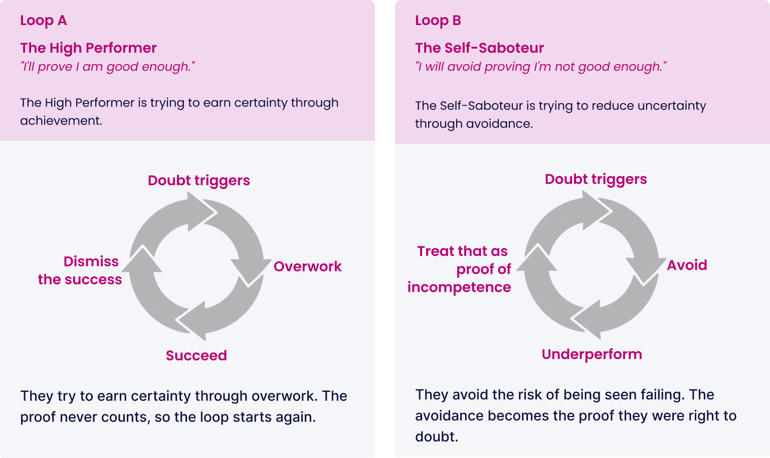
Neither loop breaks with confidence-building. The evidence is already there. The client is rejecting it. That is a cognition problem, not a confidence problem.
Free 75-Minute Live Masterclass
.png?width=500&height=380&name=Image%20with%20dates@2x%20(8).png)
You're the unofficial coach.
People development is in your remit, and coaching conversations land on you whether or not "coach" is in your title.

You want a framework, not another engagement initiative.
You're looking for something grounded in research and clinical practice that you can apply in one-on-ones, talent reviews, and development programs.

You know it's affecting you, too.
HR professionals are high achievers in a role where everyone watches. If you're hesitating, over-preparing, or playing smaller than your experience warrants, this applies to you first.
Coach

CEO, Clark Training & Consulting

ADHD Coach for Professionals in Tech
Leadership Coach

Career Coach

Executive Coach and Learning & Development Specialist

Business Coach

Wellness Coach

Executive Coach

Leadership Development Coach

Personal Development Coach